How a parts order and a few nudges helped grow one of TIME's Best Inventions of 2026
This week, TIME magazine named HapWare's ALEYE one of the Best Inventions of 2026. My first thought was a pitch deck from my Innov8x class at Colorado School of Mines, back when the company was still called Haptic Vision. Its second slide said only this, "Close your eyes," which was meant to expose the audience to the problem of missing nonverbal cues in conversations.
My second thought was how little it took for HapWare to go far, just a $441.27 parts order and a few pointed questions.
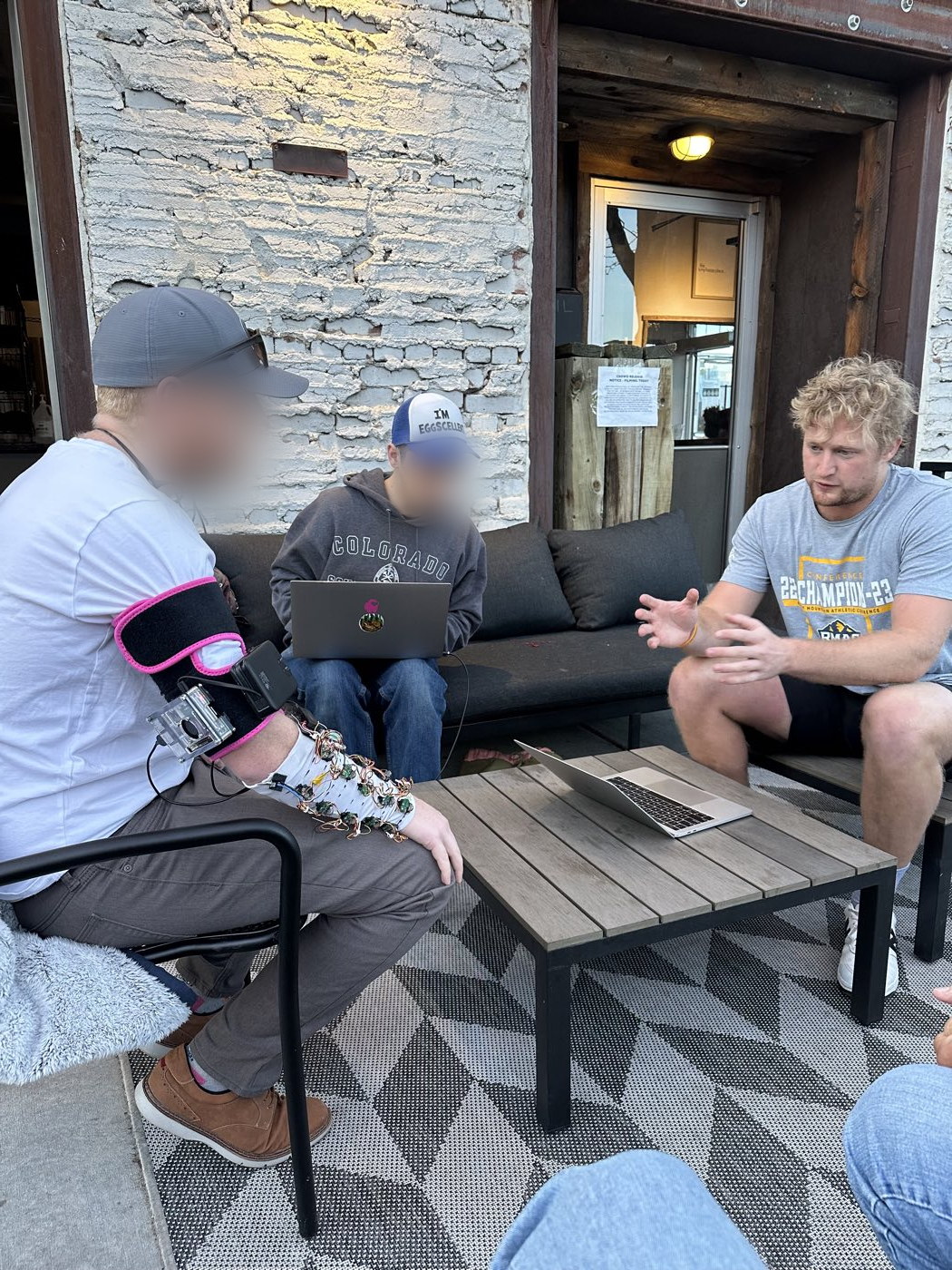
Testing the early rig with a user, well outside the classroom.
Where it really started
HapWare's story begins in a basement, before Jack Walters ever walked into my classroom. Jack, now HapWare's co-founder and CEO, has written that "HapWare started in the basement of the mechanical engineering hall at Colorado School of Mines. Colorado is where HapWare began, where ALEYE was first imagined..."
That basement housed senior design. Jack's mentor there was Dr. Bryan Duarte, now HapWare's co-founder and CTO, who lost his sight in a motorcycle accident at 18. Their mission was high-quality assistive technology for people who are blind, low-vision, or autistic. Their senior design project produced an early version of a wearable rig.
From January 2018 to August 2024, I taught Innov8x, the leading entrepreneurship class at Mines (it went by several names over the years), where I served as the inaugural director of the McNeil Center for Entrepreneurship and Innovation. Jack enrolled in spring 2024. I matched him with three other students, and Bryan kept mentoring Jack throughout.
With his new teammates, Jack iterated on their senior design rig, but it was a bulky forearm sleeve covered in exposed wiring and vibration motors, a box of electronics strapped to the body, and a camera mounted on a cap. Today's sleek ALEYE wristband, paired with smart glasses, came later, after HapWare joined Techstars and brought in professional industrial designers. If senior design produced the first rig, Innov8x is where the roots of the venture were planted: a deep focus on the problem, testing with real users and customers, and trying go-to-market strategies.
Those roots grew from small nudges that semester and what they set in motion.
Nudge one: stay with the problem, and get one thing right
While the team set out to accomplish their mission, my job was to slow them down and make sure they built a solid foundation first. In Innov8x, we pushed teams to dig for a problem's root causes before committing to a solution. I kept asking: What exactly is lost when a smile or a frown goes unseen, and how severe is it, in the users' own words?
In their early customer interviews, 75% rated the lack of equal access to nonverbal cues in person-to-person interactions at 7 out of 10 in severity. The other 25% rated it 8 or higher. Those numbers pointed past any single feature to the root problem of access to social communication itself.
That understanding shaped the device they pitched in their original deck: the haptic emotional translator that used AI and machine learning to read facial expressions and hand gestures, then translated that nonverbal communication into vibro-tactile haptic patterns on the user's forearm, discreetly and non-intrusively.
Today ALEYE conveys more than 30 cues, and new users learn seven of them in under five minutes.
Nudge two: the blindfold is not the user
Bryan mentored the team but wasn't always available to test, so for quick tests the students defaulted to a common shortcut: putting sighted teammates in blindfolds.
I pushed back. A sighted person in a blindfold is not a blind person; they haven't built a lifetime of non-visual strategies. So I asked them to put the prototype in the hands of people who are blind. They did, and kept doing it, at National Federation of the Blind chapter meetings, Helen Keller National Center, and the Austin Lighthouse for the Blind. By the time of the pitch deck, user testing had reached 95% accuracy at identifying facial expressions. One user put it this way:
When I began to feel the vibration sets and was able to interpret their meaning, it began to restore to me a once long-lost depth of everyday communication.
More recently, a beta tester Jack quoted echoed it:
I forgot what it was like to read people's expressions and body language, but now I actually feel back in the conversation.
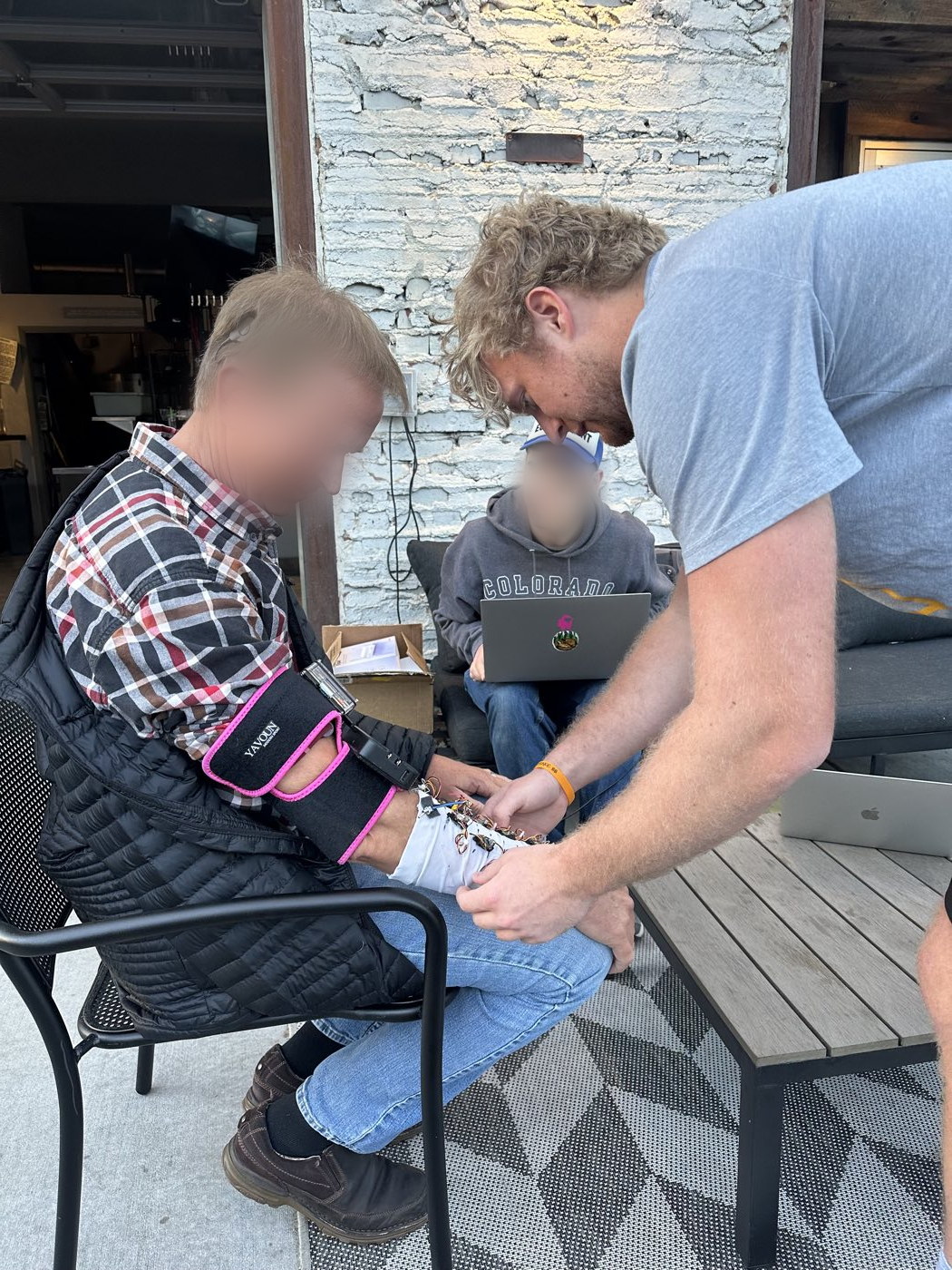
The forearm sleeve, the strapped-on electronics, the exposed wiring: the rig a $441.27 parts order built.
No blindfolded teammate could have given them an accurate perspective. And the rig behind those early tests came out of donated supply funds. I am very grateful to the many donors who empowered me to support early founders in this way, when it was too early and very risky for investors to do so.
In every Innov8x class, I offered each team up to $500 for supplies, so students didn't have to worry about where the money would come from. Removing that burden let them freely test ideas and assumptions. That's truly learning by doing. Jack and team requested parts worth $441.27.
If that $441.27 were an investment, any VC would envy the return, and HapWare's valuation is the smallest part of it. The real payoff is a product that gives people who are blind or low-vision back a part of conversation they had lost, and Jack found his calling championing a worthy innovation. I can't think of a better use of donated experimentation funds.
Nudge three: ask for commitment early
Testing with real users showed the team that the product worked, and it validated problem-solution fit. My third nudge asked whether anyone would pay for it, and they resisted this one the most. I encouraged them to sign up early beta users who would pay, even a little, while the product was still rough.
They felt the prototype wasn't ready. But a paying customer tells you something no survey or polite compliment can: this problem is worth real money to me, right now.
They did it. By the end of Innov8x, nine beta users had paid or promised to pay a small amount to get on the list and receive early versions. The deck set the next goal of 25-tester beta ahead of an MVP (the "ALEYE").
The market has since answered. HapWare opened preorders at CES 2026, with founding members getting 20% off and the first 1,000 units shipping in late 2026. The Braille Institute bought ALEYE through an Ability Central grant.
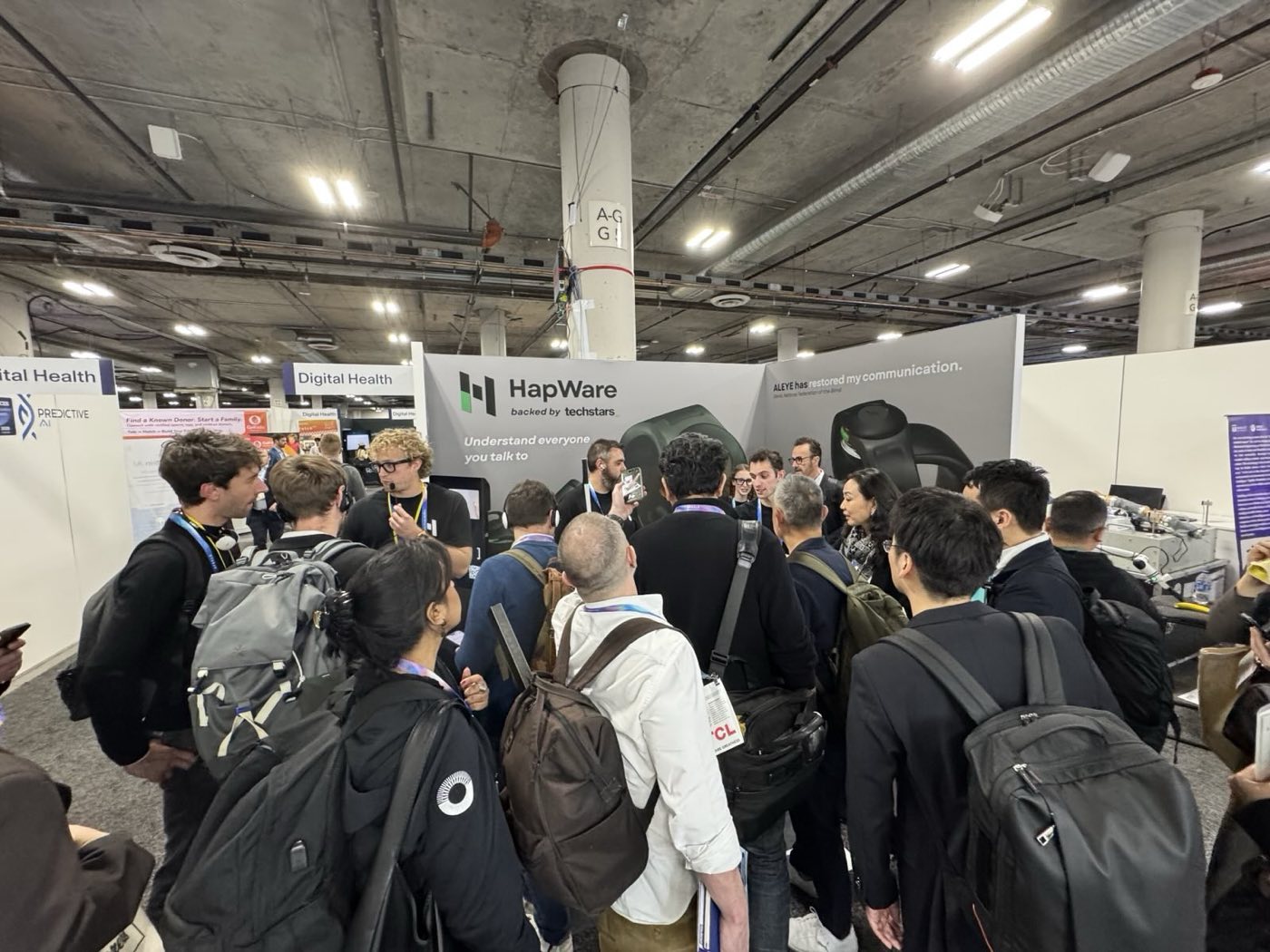
The HapWare booth at CES 2026, two years after the parts order.
Nudge four: lead the people, not just the project
Another nudge was about people leadership, not product. At one point Jack came to me frustrated with a teammate who wasn't following through on commitments. I suggested a one-on-one conversation with the teammate. Jack then handled the aftermath with real empathy and understanding. It was a small moment, but a big deal at the time, and I believe it may have shaped HapWare's team culture.
I told Jack he'd be growing a company and hiring, so he'd have to deal with employee issues. This was good learning and practice — the type you don't see in a class syllabus.
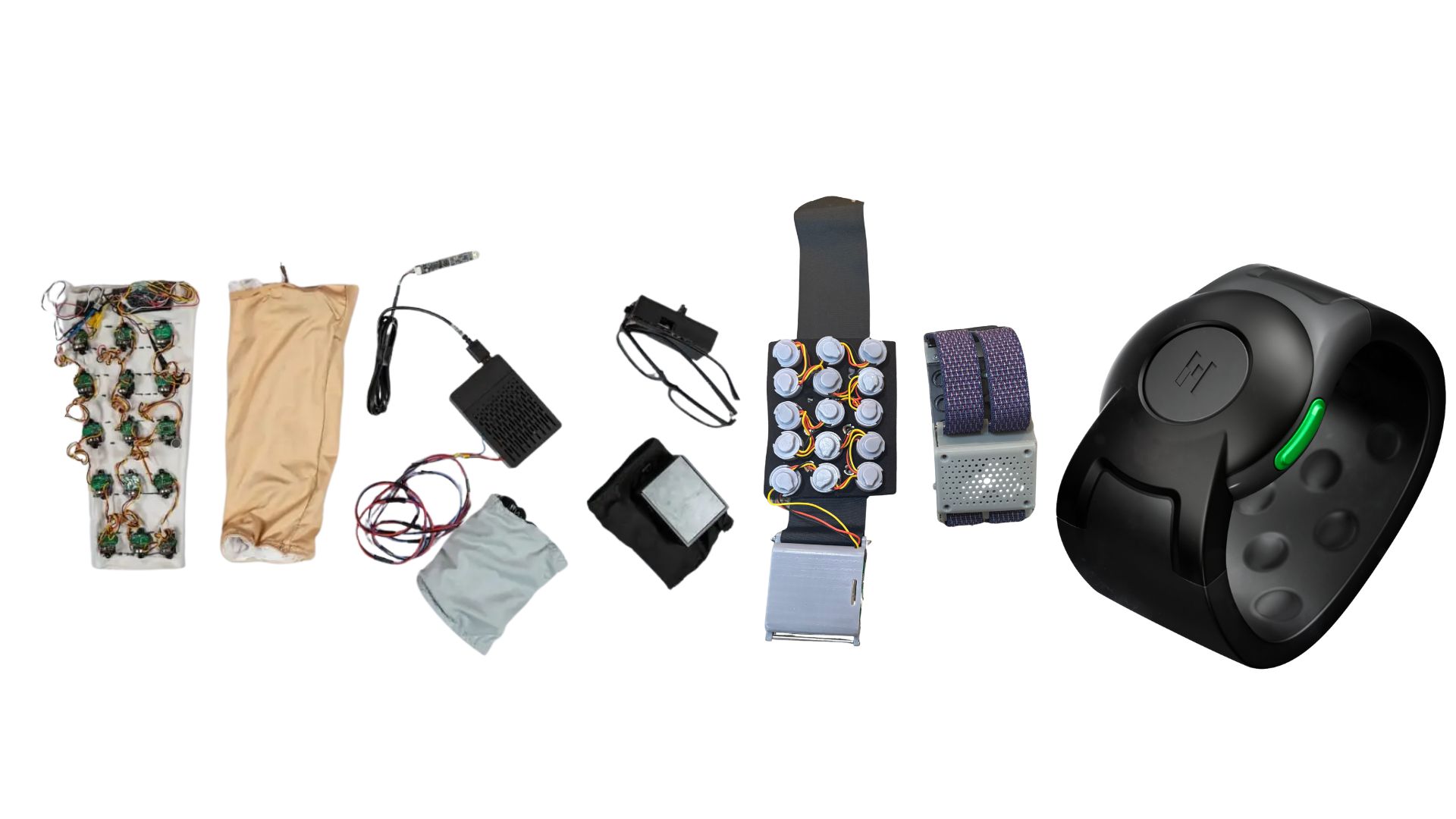
From the Innov8x-era forearm rig to today's ALEYE wristband.
Credit where it belongs
I asked questions and pushed in a few uncomfortable directions. Jack, his teammates, and Bryan did the work.
As the course wound down, Jack emailed me, "I have been meaning to ask you what a good game plan may be once we are done with the Innov8x course. We have a lot to do in the pipeline, but I want to keep the momentum we had from your course." That was the moment it became clear that this class project started becoming a venture.
The name changed first: Haptic Vision in spring 2024 became HapChic by that fall and HapWare in early 2025. Since then, HapWare has gone through Techstars ('25), won the CTA Foundation Health Innovation Challenge at CES 2026, received $250,000 from Colorado OEDIT, and raised $1.5M from investors.
Earlier this year, after a Mines showcase, Jack posted "Back where it all began." and thanked a few of us at Mines. Looking back, he puts it this way:
Innov8x planted the seed for me to become an entrepreneur and for HapWare to become a business. The Innov8x days were a critical time for learning how to test assumptions, conduct problem discovery, and pretotype both the technology and business model. As a founder who has now raised seven figures in funding, I still look back on those early days and recognize how transformative and fun they were.
Pretotype refers to Alberto Savoia's pre-prototyping approach to validation of assumptions.
What I hope you take from this
Each of these moments was small. Far from VC pitches and unicorn aspirations, this is what it looks like to focus on solving a problem that matters to a lot of people: asking one more why, finding the right testers, asking for a few dollars, having a hard conversation with a teammate. Those in-the-trenches struggles are essential to an entrepreneur's experiential learning.
Small nudges and a small budget can carry an early-stage startup a long way. An entrepreneurship class or program is not a contest for the best idea but is practice in the habits that let good ideas survive to maturity: patience to fully understand the problem, humility about who your user really is, the nerve to ask for commitment early, and empathy for the people building alongside you.
Congratulations, Jack, Bryan, and the whole HapWare team, and thanks to the students, advisors and donors who helped build Haptic Vision that semester and beyond. Watching Haptic Vision grow from an Innov8x project into one of TIME's Best Inventions has been one of the great privileges of my career. I can't wait to see what comes next.
Sid Saleh is the founder of MatrixOwl and a former faculty member at Colorado School of Mines, where he served as the inaugural director of the McNeil Center for Entrepreneurship and Innovation.